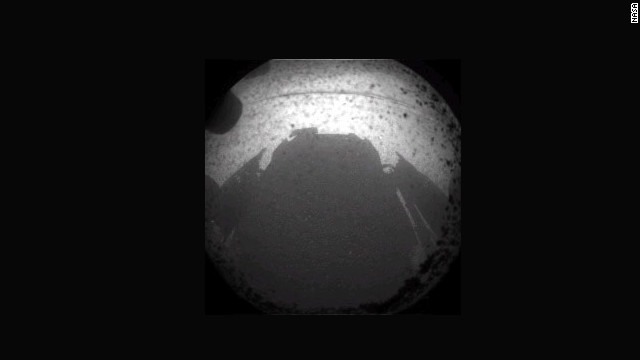
This is the first image taken by NASA's Curiosity rover, which landed on Mars the evening of Aug. 5 PDT (morning of Aug. 6 EDT). Image credit: NASA/JPL-Caltech
PASADENA, Calif. -- NASA's most advanced Mars rover Curiosity has landed on the Red Planet. The one-ton rover, hanging by ropes from a rocket backpack, touched down onto Mars Sunday to end a 36-week flight and begin a two-year investigation.
The Mars Science Laboratory (MSL) spacecraft that carried Curiosity succeeded in every step of the most complex landing ever attempted on Mars, including the final severing of the bridle cords and flyaway maneuver of the rocket backpack.
"Today, the wheels of Curiosity have begun to blaze the trail for human footprints on Mars. Curiosity, the most sophisticated rover ever built, is now on the surface of the Red Planet, where it will seek to answer age-old questions about whether life ever existed on Mars -- or if the planet can sustain life in the future," said NASA Administrator Charles Bolden. "This is an amazing achievement, made possible by a team of scientists and engineers from around the world and led by the extraordinary men and women of NASA and our Jet Propulsion Laboratory. President Obama has laid out a bold vision for sending humans to Mars in the mid-2030's, and today's landing marks a significant step toward achieving this goal."
Curiosity landed at 10:32 p.m. Aug. 5, PDT, (1:32 a.m. EDT Aug. 6) near the foot of a mountain three miles tall and 96 miles in diameter inside Gale Crater. During a nearly two-year prime mission, the rover will investigate whether the region ever offered conditions favorable for microbial life.
"The Seven Minutes of Terror has turned into the Seven Minutes of Triumph," said NASA Associate Administrator for Science John Grunsfeld. "My immense joy in the success of this mission is matched only by overwhelming pride I feel for the women and men of the mission's team."
Curiosity returned its first view of Mars, a wide-angle scene of rocky ground near the front of the rover. More images are anticipated in the next several days as the mission blends observations of the landing site with activities to configure the rover for work and check the performance of its instruments and mechanisms.
"Our Curiosity is talking to us from the surface of Mars," said MSL Project Manager Peter Theisinger of NASA's Jet Propulsion Laboratory in Pasadena, Calif. "The landing takes us past the most hazardous moments for this project, and begins a new and exciting mission to pursue its scientific objectives."
Confirmation of Curiosity's successful landing came in communications relayed by NASA's Mars Odyssey orbiter and received by the Canberra, Australia, antenna station of NASA's Deep Space Network.
Curiosity carries 10 science instruments with a total mass 15 times as large as the science payloads on the Mars rovers Spirit and Opportunity. Some of the tools are the first of their kind on Mars, such as a laser-firing instrument for checking elemental composition of rocks from a distance. The rover will use a drill and scoop at the end of its robotic arm to gather soil and powdered samples of rock interiors, then sieve and parcel out these samples into analytical laboratory instruments inside the rover.
To handle this science toolkit, Curiosity is twice as long and five times as heavy as Spirit or Opportunity. The Gale Crater landing site places the rover within driving distance of layers of the crater's interior mountain. Observations from orbit have identified clay and sulfate minerals in the lower layers, indicating a wet history.
The mission is managed by JPL for NASA's Science Mission Directorate in Washington. The rover was designed, developed and assembled at JPL. JPL is a division of the California Institute of Technology in Pasadena.
For more information on the mission, visit: http://www.nasa.gov/mars and http://marsprogram.jpl.nasa.gov/msl .
Follow the mission on Facebook and Twitter at: http://www.facebook.com/marscuriosity And http://www.twitter.com/marscuriosity .
ARE YOU TOTALLY INTO THE FIRST IMAGES FROM CURIOSITY? OMG. So am I. Stay TUNED. Within just about two hours... the very first images are likely to arrive more after landing, due to the timing of NASA's signal-relaying Odyssey orbiter. I will post them ASAP.... This is BETTER than the OLYMPICS.... Trust me on this one....
Here is the INSIDE SCOOP from NASA:
"The images will be captured with the left and right Hazcams at the back and front of the rover, and they will not yet be full-resolution (the two images arriving on Earth first are "thumbnail" copies, which are 64 by 64 pixels in size).
The Hazcams are equipped with very wide-angle, fisheye lenses, initially ca
English: This artist's concept from an animation depicts Curiosity, the rover to be launched in 2011 by NASA's Mars Science Laboratory, as it is being lowered by the mission's rocket-powered descent stage during a critical moment of the "sky crane" landing in 2012. Image Credit: NASA/JPL (Photo credit: Wikipedia)
pped with clear dust covers. The covers are designed to protect the cameras from dust that may be kicked up during landing; they are clear just in case they don't pop off as expected.
These first views will give engineers a good idea of what surrounds Curiosity, as well as its location and tilt. "Ensuring that the rover is on stable ground is important before raising the rover's mast," said Mission Manager Jennifer Trosper at JPL. "We are using an entirely new landing system on this mission, so we are proceeding with caution."
Color pictures from the rover's Mars Descent Imager, or MARDI, acquired as the rover descends to the Martian surface, will help pinpoint the rover's location. Initial images from MARDI are expected to be released Aug. 6, the day after landing.
These will also be in the form of thumbnails (in the case of the science cameras, thumbnails can vary in size, with the largest being 192 pixels wide by 144 pixels high). One full-resolution image may also be returned at this time."
I have CURIOSITY FEVER! What an amazing day for MAN kind this coming Monday morning. Here is the latest from NASA and the super smart folks over at JPL in Pasadena.
WASHINGTON -- NASA's newest Mars mission, will draw on support from missions sent to Mars years ago and will contribute to missions envisioned for future decades.
"Curiosity is a bold step forward in learning about our neighboring planet, but this mission does not stand alone. It is part of a sustained, coordinated program of Mars exploration," said Doug McCuistion, director of the Mars Exploration Program at NASA Headquarters in Washington. "This mission transitions the program's science emphasis from the planet's water history to its potential for past or present life."
As the Mars Science Laboratory spacecraft places the Curiosity rover on the surface of Mars next week, NASA will be using the Mars Odyssey orbiter, in service since 2001, as a relay for rapidly confirming the landing to Curiosity's flight team and the rest of the world. Earth will be below the Mars horizon from Curiosity's perspective, so the new rover will not be in direct radio contact with Earth. Two newer orbiters also will be recording Curiosity's transmissions, but that data will not be available on Earth until hours later.
When Curiosity lands beside a mountain inside a crater at about 1:31 a.m. EDT, Aug. 6 (10:31 p.m. PDT Aug. 5), the 1-ton rover's two-year prime mission on the surface of Mars will begin. However, one of the rover's 10 science instruments, the Radiation Assessment Detector (RAD), already has logged 221 days collecting data since the spacecraft was launched on its trip to Mars on Nov. 26, 2011.
"Our observations already are being used in planning for human missions," said Don Hassler of Southwest Research Institute in Boulder, Colo., principal investigator for Curiosity's RAD.
The instrument recorded radiation spikes from five solar flare events spewing energetic particles from the sun into interplanetary space. Radiation from galactic cosmic rays, originating from supernova explosions and other extremely distant events, accounted for more of the total radiation experienced on the trip than the amount from solar particle events. Inside the spacecraft, despite shielding roughly equivalent to what surrounds astronauts on the International Space Station, RAD recorded radiation amounting to a significant contribution to a NASA astronaut's career-limit radiation dose.
Curiosity's main assignment is to investigate whether its study area ever has offered environmental conditions favorable for microbial life. To do that, it packs a science payload weighing 15 times as much as the science instruments on previous Mars rovers. The landing target, an area about 12 miles by 4 miles (20 kilometers by 7 kilometers), sits in a safely flat area between less-safe slopes of the rim of Gale Crater and the crater's central peak, informally called Mount Sharp. The target was plotted to be within driving distance of layers on Mount Sharp, where minerals that formed in water have been seen from orbit.
"Some deposits right inside the landing area look as though they were deposited by water, too," said John Grotzinger of the California Institute of Technology (Caltech) in Pasadena, project scientist for Curiosity. "We have a great landing site that was a strong science contender for earlier missions, but was not permitted for engineering constraints because no earlier landing could be targeted precisely enough to hit a safe area inside Gale Crater. The science team feels very optimistic about exploration of Mount Sharp and the surrounding region that includes the landing ellipse."
Mission engineers designed a sky crane maneuver, lowering Curiosity on nylon cords from a rocket backpack because the rover is too heavy to use the airbag system developed for earlier rovers. "We know it looks crazy," said Adam Steltzner of NASA's Jet Propulsion Laboratory (JPL) in Pasadena, leader of the team that developed the system. "It really is the result of careful choices." By designing the aeroshell enclosing Curiosity to create lift and be steerable, engineers were able to build a system that lands much more precisely instead of dropping like a rock.